top of page
Search

The Hidden Cost of End-Bits: Why Leftover Fabric Is Costing You More Than CAD Can Save

  • Writer: jazasoft751
    jazasoft751
  • May 12
  • 3 min read

In the Garment Manufacturing industry, fabric accounts for 60–70% of garment cost — yet most factories still lose 2–5% of it silently. Not in CAD. Not in markers. But on the cutting floor.
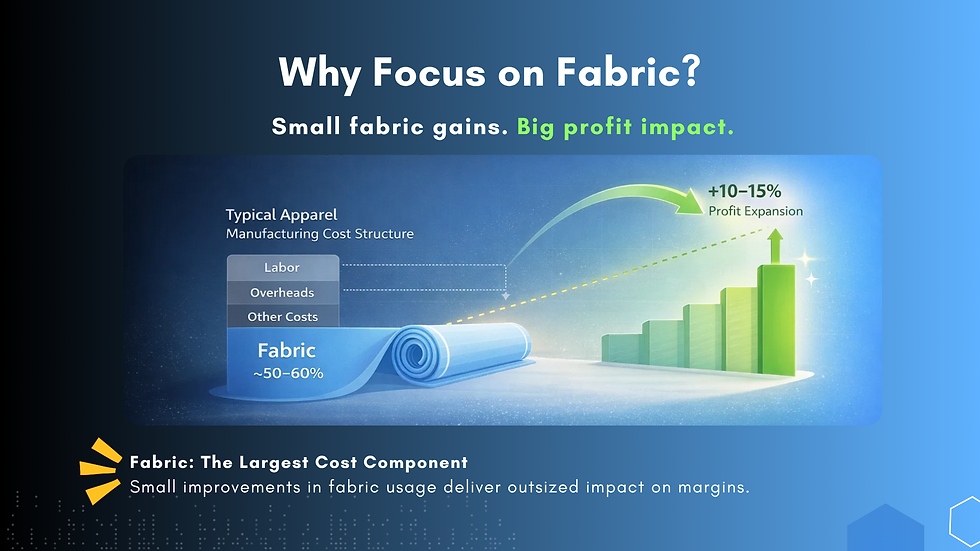
Over the years, manufacturers have invested heavily in CAD systems, marker optimization, and auto-nesting tools. Marker efficiencies are closely tracked, reviewed, and pushed to their practical limits. Yet, despite all these efforts, actual fabric consumption often remains unchanged. On paper, efficiencies improve — but on the shop floor, savings don’t reflect.

This leads to a common misconception: that further improvements must come from better CAD systems or more advanced automation. In reality, most factories have already extracted maximum value from marker optimization. The real problem lies elsewhere.


Where the Fabric Really Gets Lost

The hidden loss begins in the cutting room — after the marker is finalized.

Fabric rolls arrive in varying lengths, while marker lengths remain fixed. During cutting, each roll leaves behind small leftover pieces — sometimes 10 meters, sometimes 5, sometimes just 1–2 meters. Individually, these seem insignificant.


These leftovers, known as end-bits, are usually stored with the intention of reuse — for smaller markers, panels, or garment replacements. However, in practice, most of them never get utilized. They got misplaced on the floor or left idle in racks, forgotten, or eventually sold as scrap.


What appears minor at the roll level accumulates into 2–5% fabric wastage at the factory level, directly impacting profitability.


A Problem Hidden in Plain Sight

Factories often attempt to control this through SOPs or manual tracking, but results remain inconsistent.


In deeper studies across multiple factories, another issue surfaced. While standard end loss per layer is defined as 2 cm, actual losses on the cutting table frequently reach 4–5 cm. This silent variation reduces cut quantities and increases fabric consumption — yet goes unnoticed due to lack of control systems.


Beyond CAD: Bringing Intelligence to Roll Planning

This is where OptaCut by Jaza Software makes a real difference.

OptaCut does not focus only on markers — it focuses on how fabric is actually used on the cutting floor, where most of the loss happens. Before cutting starts, the system helps decide which roll should be used for which marker, instead of leaving it to guesswork or availability.


It considers things like fabric width, shade, shrinkage, and order needs, and then suggests the best roll to use. It also keeps a check on end loss per layer and alerts the team if the wastage is going beyond the allowed limit.


At the same time, it guides how many plies should be cut from each roll so that maximum fabric is used. Even the leftover fabric is not ignored — OptaCut plans in advance where that leftover can be used next.


With this approach, the cutting team does not have to depend on assumptions. Everything is guided step by step, which helps reduce mistakes and avoid unnecessary fabric loss.


The Impact on Cost and Profitability

Factories implementing intelligent roll planning through OptaCut have unlocked up to 5% fabric savings — not by changing inputs, but by eliminating hidden inefficiencies on the cutting floor.


This translates into:

  • Drastic reduction in end-bits that were previously untracked and underutilized

  • Significant decline in dead stock, freeing up working capital locked in cutting rooms

  • Tighter control over actual vs. planned consumption, eliminating silent losses from excess end loss and poor roll selection

Importantly, these savings come without changing fabric quality, workforce, or production speed — only by using existing fabric more efficiently.

Instead, the improvement comes from bringing intelligence, visibility, and control into roll-level planning — an area that has traditionally been manual and assumption-driven.

In simple terms, OptaCut doesn’t ask you to do more. It ensures you stop losing what you already have.


Conclusion: End-Bits Are Not Inevitable

For decades, end-bits were considered unavoidable and remained a hidden cost. With OptaCut, this is no longer the case.


By bringing data-driven decision-making to the cutting room, real-time control over fabric utilization, OptaCut ensures better roll utilization, transforms end-bits from unavoidable waste into a manageable with minimal leftovers.


Because in garment manufacturing, every meter of fabric saved goes straight to profit.

Want to know how much fabric your cutting room is losing? Let’s connect and analyze your data.


Comments


Apparel Management Software for Modern Garment Manufacturing

Transform Your Factory with Smart Apparel Production Technology

In today’s competitive fashion industry, manufacturers need more than spreadsheets and manual tracking to manage operations efficiently. Modern Apparel Management Software helps garment factories streamline production, improve visibility, reduce waste, and increase profitability through real-time digital control.

Jazasoft provides advanced solutions designed specifically for apparel manufacturers looking to accelerate digital transformation in apparel manufacturing and optimize every stage of production.

What Is Apparel Management Software?

Apparel Management Software is an integrated digital platform that helps apparel manufacturers manage planning, production, quality, inventory, costing, and factory operations from a single system. It enables manufacturers to make faster decisions using real-time production data and automated workflows.

Whether you operate a small garment unit or a large-scale manufacturing facility, modern Garment Factory Software improves operational efficiency and production accuracy across departments.

Why the Fashion Industry Needs Digital Transformation

The apparel industry is rapidly evolving due to increasing buyer demands, shorter lead times, rising production costs, and stricter quality standards. Traditional systems often create delays, communication gaps, and inaccurate reporting.

This is why digital transformation in apparel manufacturing has become essential for factories aiming to stay competitive in global markets.

With advanced Fashion Manufacturing Software, manufacturers can:

  • Monitor production in real time

  • Reduce manual errors

  • Improve line efficiency

  • Track quality performance

  • Optimize resource utilization

  • Reduce operational costs

  • Increase on-time deliveries

Digitalization allows apparel businesses to move from reactive management to data-driven decision-making.

Key Features of Apparel Factory Digitalization Software

Real-Time Production Tracking

Modern Apparel factory digitalization software provides live production visibility across sewing lines, cutting, finishing, and packing departments. Managers can instantly monitor output, efficiency, downtime, and bottlenecks.

Production Planning & Scheduling

Efficient planning is critical in garment manufacturing. Advanced Apparel Business Software helps manufacturers create production schedules, allocate resources, and track order progress accurately.

Quality Management System

Integrated quality modules help reduce defects, improve compliance, and maintain product consistency throughout production.

Inventory & Material Management

Track raw materials, trims, fabrics, and accessories in real time to avoid shortages and reduce excess inventory.

Cost Control & Waste Reduction

Powerful reporting and analytics help manufacturers identify production inefficiencies, control labor costs, and minimize fabric waste.

Performance Analytics

Data-driven dashboards allow management teams to measure factory KPIs and improve operational performance continuously.

Benefits of Fashion Manufacturing Software

Implementing modern Fashion Industry Software offers several advantages for apparel manufacturers:

Increased Factory Efficiency

Automated workflows and digital tracking reduce delays and improve production speed.

Better Decision-Making

Real-time dashboards provide actionable insights for faster operational decisions.

Improved Buyer Compliance

Digital systems help manufacturers maintain quality standards and production transparency required by international buyers.

Reduced Production Costs

Better planning and resource optimization help lower operational expenses and reduce waste.

Scalable Operations

As your business grows, modern Garment Factory Software can scale with your production requirements.

Why Choose Jazasoft?

Jazasoft Apparel Software Solutions are designed specifically for garment manufacturers seeking operational excellence through digital transformation. The platform combines production management, quality control, reporting, and factory analytics into one centralized solution.

Whether you need Fashion Manufacturing Software, Apparel Business Software, or complete Apparel factory digitalization software, Jazasoft helps manufacturers improve productivity, visibility, and profitability with industry-focused technology.

Start Your Apparel Factory Digital Transformation Today

The future of apparel manufacturing depends on efficiency, automation, and real-time visibility. Investing in advanced Fashion Industry Software enables manufacturers to stay competitive, reduce costs, and improve production performance.

Modern Apparel Management Software is no longer optional — it is the foundation of smart garment manufacturing operations.

© 2023 Apparel Manufacturing Software. All rights reserved.

bottom of page